Can quantum control be certified without a unique model?
A restricted measurement can leave several Hamiltonians compatible with the data. My one-qubit study asks what control performance can still be guaranteed.

Suppose an experiment fits a Hamiltonian well. A controller designed for that fit also performs well in simulation. Neither observation says what happens if a different Hamiltonian would have produced the same measurements.
That is the question I examined in a September 2026 technical study: what quantum-control performance can be guaranteed when the available preparations and measurements constrain a set of possible physical models, rather than identify one unique model? A second question follows naturally. Which additional experiment improves the guarantee for the task, instead of merely making a parameter estimate look more precise?
The result so far is a defined certification problem and a small, reproducible illustration. It is not a general certification algorithm or a quantum-hardware result.
The model set is the object of the guarantee
System identification depends on what the experiment can actually prepare, control and observe. Two models can be operationally indistinguishable under one experiment library even if their Hamiltonians differ. Burgarth and Yuasa’s identification framework makes the attainable experiment setting central to the question of what can be known.
I therefore start with a declared physical model domain and retain every model compatible with the data and assumptions. This set may have disconnected branches. A confidence interval around one fitted parameter vector can miss another branch entirely. Repeating the same non-discriminating measurement reduces sampling noise without resolving that structural ambiguity.
There are two distinctions to keep straight:
- Exact observational equivalence means two models predict the same outcome probabilities for every protocol in a specified identification library. That is an equivalence relation.
- A finite-data consistency set contains models whose predictions satisfy stated statistical constraints. Being close to measured frequencies does not itself define an equivalence relation.
The set need not collapse to one model. Classical data-informativity work already shows that useful analysis or control can sometimes proceed without unique identification. Keeping all compatible models is therefore a starting point from prior research, not a novelty claim of this study.
For a control (u), task loss ℓ and additional perturbation budget Δ(r), the certificate I want has the form:
B_D(u, r) ≥ sup{ℓ(u, m, d) : m ∈ M(D), d ∈ Δ(r)}. Issue a certificate only if the data-compatible set M(D) is nonempty and B_D(u, r) ≤ ε, where ε is the declared loss tolerance.
The physical assumptions, allowed controls, target, measurement frame, loss and units of the perturbation radius must all be specified. A sampled parameter sweep can find failures; it cannot certify a continuum of models that it has not searched.
A one-qubit example exposes the ambiguity
Take a deliberately restricted, calibrated qubit model:
H = (ω + u)Z/2
The unknown drift is in two physical branches around ω = ±1. Identification prepares the X-positive state, evolves freely for one unit of time and reads out X. Its positive-outcome probability is (1 + cos ω)/2. Because cosine is even, ω = +1 and ω = −1 give exactly the same X statistics. More shots of that experiment cannot tell them apart.
Now fix the control duration at T = π/2, allow only commuting Z control u ∈ [−2, 2], and ask for the calibrated target gate Rz(π/2). The process fidelity is Fₚ(u,ω) = cos²[(ω + u − 1)π/4]. Process fidelity here is the gate-overlap measure for the stated unitary target; it is not average gate fidelity.
For the compatible pair ω = ±1, Fₚ(u,+1) + Fₚ(u,−1) = 1 for every allowed control. So the smaller fidelity cannot exceed 0.50. A controller fitted only to the positive branch chooses u = 0: its fidelity is 1 on that branch and 0 on the other. The blue curve in the analytic figure below is what survives when both models are retained.
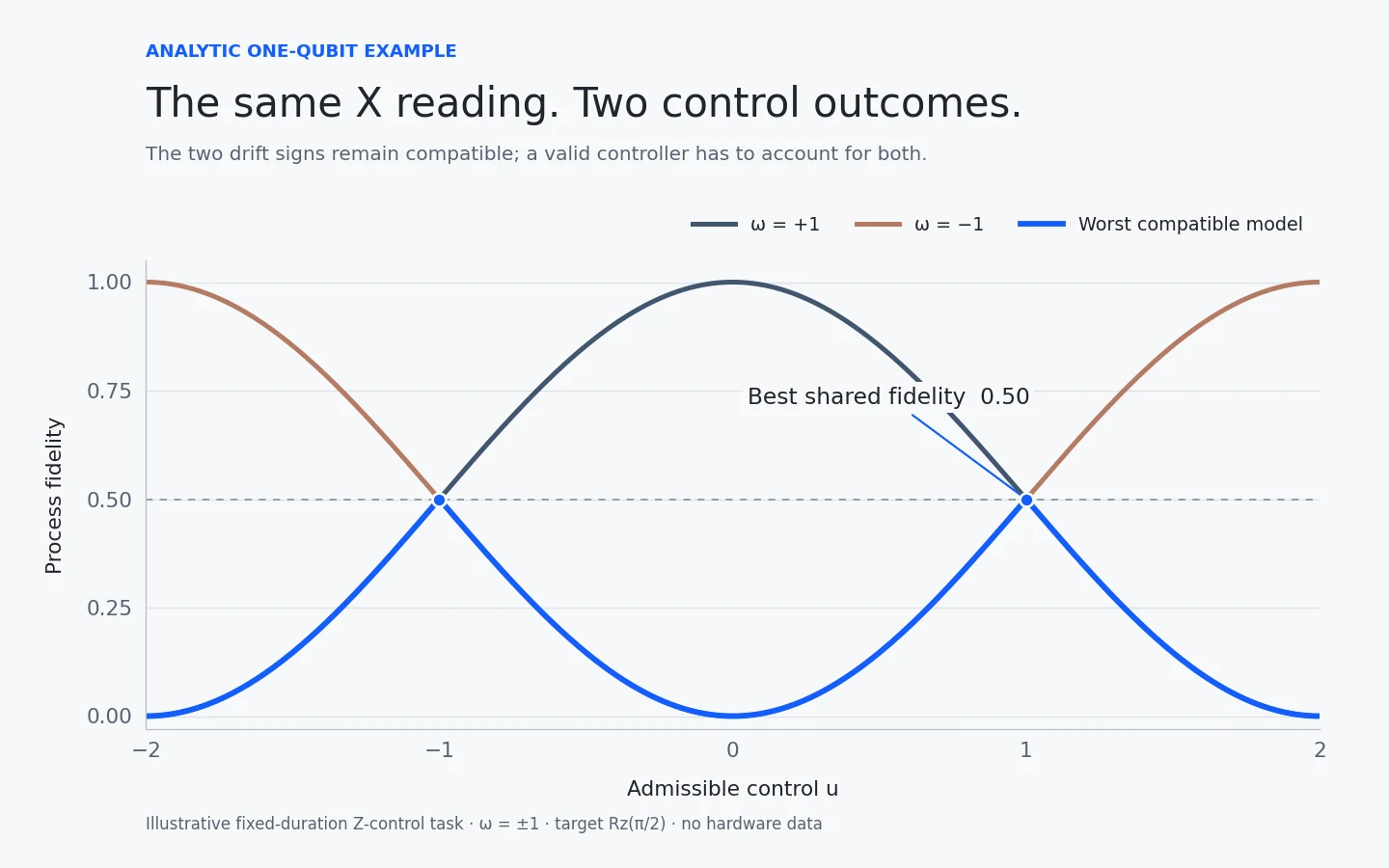
The 0.50 ceiling depends on the fixed duration, calibrated frame and commuting control class. Changing those conditions can change the result. It is an obstruction for this task and experiment library, not a universal limit on quantum control.
A calibrated Y readout produces (1 + sin ω)/2, which separates the signs. At ω = ±1, the X and Y probabilities are about 0.770 in both cases for X, but about 0.921 and 0.079 for Y. The useful feature of Y is that it removes a global alias that matters to the task. Local parameter precision alone can miss that distinction.
Equal shot budgets, different guarantees
I also compared two predeclared synthetic measurement designs, each using 8,192 reset shots and a separately constructed 95% model-set coverage statement. Design A takes two X batches. Design B takes one X and one Y batch. Both use the same physical prior and true simulated value ω = 1. The study fixes the NumPy seed at 20260923 and records the batch counts: X gives 3,091/4,096 and 3,146/4,096 successes; Y gives 3,790/4,096.
| Evaluation | Process-fidelity floor |
|---|---|
| X-only: positive branch retained, negative branch wrongly discarded | 0.999235 apparent |
| Same controller, both X-compatible branches retained | 0.000019 actual worst case |
| X-only: a robust controller over both branches | 0.488360 |
| X plus Y: controller over the retained single interval | 0.998215 |
The X-plus-Y compatible interval is approximately [0.9817915, 1.0893959]. It is wider than one X-only branch. The improvement comes from removing the competing sign, not from a narrower local interval. In this analytic model, the midpoint control is approximately u = −0.035594 and the worst-case process fidelity is cos²[(b − a)π/8] ≈ 0.998215. For a separately defined constant drift |d| ≤ r, the same stated model retains Fₚ ≥ 0.99 through r ≈ 0.073735 normalized angular-frequency units.
These are rounded evaluations of closed-form extrema on the declared model. The implementation used ordinary floating-point arithmetic, not an outward-rounded interval proof engine. The comparison is one synthetic realization, not evidence that X-plus-Y or a certificate-oriented adaptive policy wins generally.
Statistical coverage and robust performance are different claims
A finite-shot model set needs a statistical contract. For fixed binary protocols with independent reset shots, the study uses Hoeffding radii and a union bound to retain the true stationary model with probability at least 1 − α, conditional on the declared physical domain and sampling assumptions. An adaptive experiment sequence would need a valid sequential error budget or confidence sequence; repeatedly reusing an ordinary fixed-time 95% interval after optional stopping would not suffice.
The performance calculation then needs a deterministic upper bound over the entire retained set. If the set contains the true model and the bound is sound, an issued certificate covers that model. Under the stated assumptions, the probability of issuing an invalid certificate is at most the model-set noncoverage probability. This is not automatically the error rate among certificates that happen to be issued.
An empty compatible set means the data and model assumptions conflict. It is a diagnostic, not a vacuous success. Device drift, uncertain calibration, preparation errors and readout-phase errors must either enter the model or be tested as model mismatch. More shots do not make an omitted physical mechanism disappear.
Choose experiments for the task they unlock
The research direction is to score a feasible new experiment by its effect on a certified task loss or robustness radius, accounting for shots, interrogation time and computation. That is a different objective from minimizing a fitted Hamiltonian’s covariance. Active Hamiltonian learning already selects informative queries, so an adaptive measurement rule by itself would not be new. A contribution would need a defensible task-based objective, a sound verifier and a measured gain under matched resources.
A related two-parameter sensing example makes the same issue visible. If a target phase a and nuisance phase b only enter as a + b, one sensitive readout cannot distinguish them. A second calibrated protocol that responds to −a + b can separate them under a stated principal phase domain and stable nuisance assumptions. Nuisance-aware quantum estimation is established literature; this reduced calculation specifies what an eventual application experiment would have to resolve. It is not a simulation or result from an atom interferometer.
What comes next, and what the study does not establish
The next technical step is a verifier for low-dimensional, possibly disconnected compatible-model sets. It must keep every unresolved branch, produce an upper loss bound over a continuum and expose how conservative that bound is. A controller optimiser may propose candidates; an independent verification step must certify them. Published differential sensitivity bounds provide a comparison baseline, but a local sensitivity result does not automatically cover a remote compatible branch.
Only after that can fixed, estimation-oriented and certificate-oriented experiment designs be compared fairly on the same physical prior, control class, shot budget, interrogation time and computation. Failures to certify and model-mismatch cases belong in the results. A later optical-lattice application would require a specified apparatus model, available measurements and actual experimental access.
My earlier QANTIS research supplies experience with quantum experiments, uncertainty and classical baselines. QFlow Studio could keep the eventual experiment record reproducible. Neither is the scientific contribution claimed here. The present output is a research formulation, analytic examples and a bounded synthetic calculation. A general method, an adaptive-policy benchmark, an open-system extension and laboratory validation remain open work.
Sources
- Burgarth and Yuasa, Quantum System Identification (2012) journals.aps.org
- van Waarde et al., Data informativity (2020) arxiv.org
- O'Neil et al., Differential sensitivity bounds for dynamic quantum control (2024) arxiv.org
- Dutt et al., Active learning of quantum system Hamiltonians (2023) journals.aps.org
- Suzuki, Yang and Hayashi, Quantum state estimation with nuisance parameters (2020) arxiv.org