Bayram Eker

Home / Research

Research

Hardware-calibrated decision inference under uncertainty, and a layered architecture for hybrid intelligent systems. Everything here is a public preprint or a self-authored reference architecture. None of it is peer-reviewed journal acceptance, and none of it claims quantum advantage over strong classical methods.

Three questions I keep returning to

Decision inference under uncertainty
Belief updating, multi-target data association and POMDP planning, where the quantum layer is a bounded primitive inside a classical loop and never the thing holding action authority.
Evidence-first experimentation
Calibration conditions, classical baselines, backend identity and operating envelopes kept attached to results, so that a reader can tell what a number means and where it stops meaning it.
Governed agentic systems
Agent orchestration in which drafting is cheap, consequential execution is human-approved, and the whole run stays inspectable after the fact.

The QANTIS programme

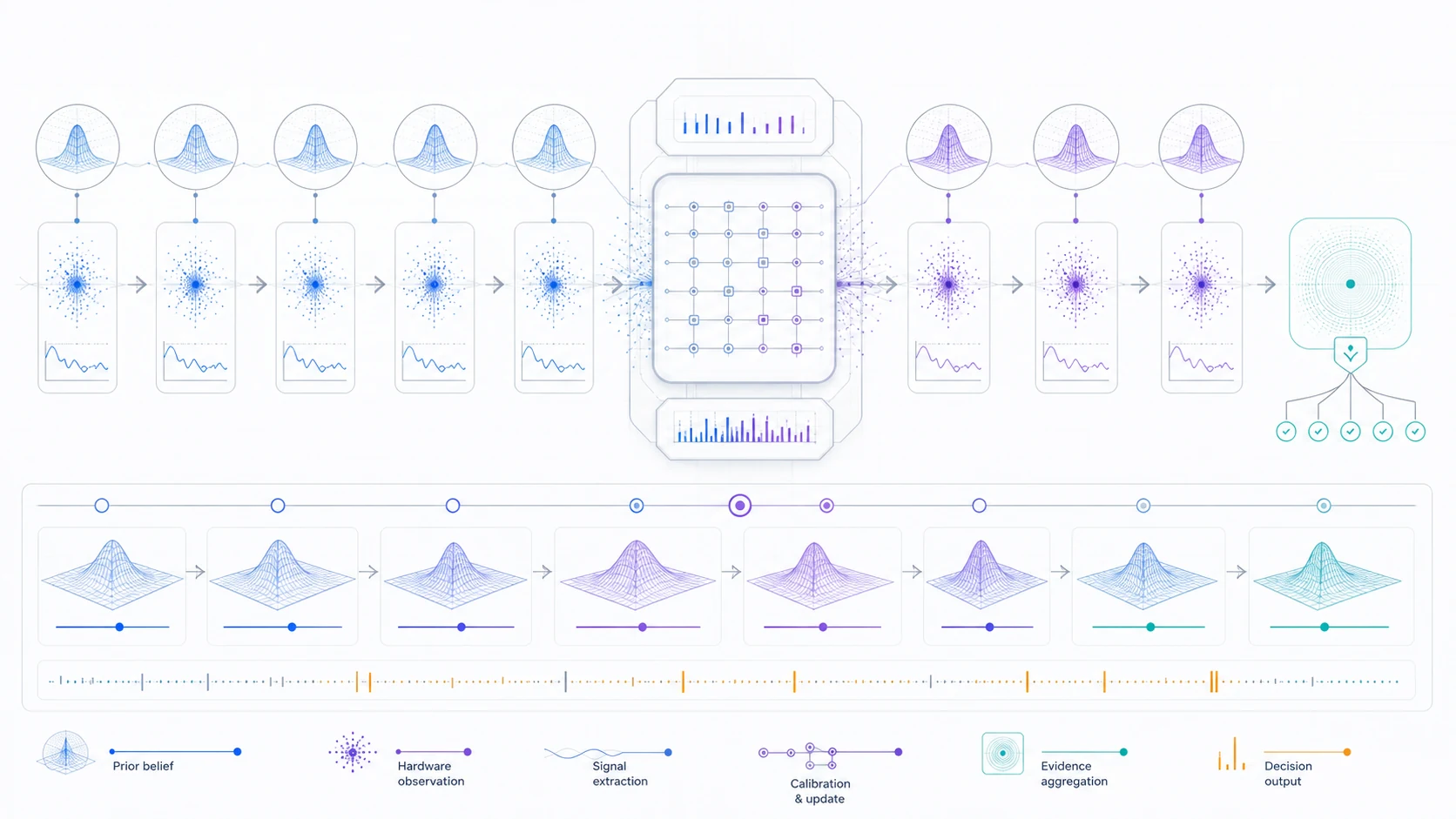
QANTIS asks something narrow on purpose. Can a quantum belief-update primitive be trusted inside a classical decision loop, on the hardware that exists today? The first paper establishes the platform and the mechanism across a broad hardware campaign. The second asks the harder follow-on, which is whether that primitive survives repeated use as error accumulates along a trajectory. In both, the planner and the action authority stay classical.

Observation noisy, rare Quantum belief update calibrated Posterior vs exact Bayes Classical planner action authority Action then repeat sequential loop over 8, 12, 20 and 32 steps
The quantum layer is a bounded primitive. The planner and the action authority stay classical, and the sequential study asks whether the primitive survives repeated trips around this loop.
Preprint

arXiv:2603.00785 · 28 February 2026

QANTIS: A Hardware-Validated Quantum Platform for POMDP Planning and Multi-Target Data Association

Bayram Yüksel Eker, Şuayb Ş. Arslan, Özgür Nazlı, Mustafa Serhat Demirgil, Furkan Deligöz. First author · platform lead.

A modular quantum platform for belief update and multi-target data association under partial observability, validated through a 45-experiment campaign across three IBM Heron backends rather than in simulation alone.

Can a quantum belief-update mechanism and its surrounding platform operate on real hardware, with results that survive calibration-aware scrutiny?

Hardware campaign
45 experiments · 3 IBM Heron backends
Mechanism validation
Rare-observation probability amplified 0.179 → 0.907
Posterior fidelity
Hellinger distance 0.0015 against exact Bayes
Framing
Controlled mechanism validation, not a classical replacement
Record
31 pages, 4 figures, 12 tables. quant-ph, cross-listed cs.AI
Method and stated limits
  • Quantum belief update through Grover amplitude amplification and BIQAE
  • QUBO-based multi-target data association solved with FPC-QAOA
  • Composable error mitigation applied across the pipeline
  • 45 experiments executed across three IBM Heron backends
  • Calibration conditions, mitigation settings and backend identity retained per run

What the paper does not claim

  • Public preprint — not peer-reviewed journal acceptance.
  • No wall-clock quantum advantage over strong classical methods is claimed.
  • No claim of universal hardware scalability or production readiness.
  • No claim of end-to-end autonomy or real-time operational deployment.
Preprint

arXiv:2607.06760 · 9 July 2026

QANTIS: Hardware-Calibrated Sequential POMDP Belief Updates on IBM Heron

Bayram Yüksel Eker, Şuayb Ş. Arslan, Mustafa Serhat Demirgil. First author.

A sequential follow-on study asking whether a calibrated quantum belief-update service can be reused repeatedly inside a classical decision loop, without cumulative noise making the posterior unusable.

Does the belief-update primitive survive repeated use across a trajectory, or does error accumulate until the decision changes?

Primary runs
8-step and 12-step sequential campaigns
Controls
20-step and 32-step longer-horizon probes
Decision consistency
Hardware and exact-Bayes posteriors chose the same action in every reported check
Result type
A decision-level operating envelope
Setting
Sequential Tiger POMDP horizon on IBM Heron
Method and stated limits
  • Belief-update service embedded inside a classical planner — action authority stays classical
  • Primary campaigns over 8-step and 12-step decision loops
  • 20-step and 32-step controls to probe longer-horizon stability
  • Hardware-derived posteriors compared against exact Bayes at every decision point

What the paper does not claim

  • Public preprint — not peer-reviewed journal acceptance.
  • The quantum module does not replace classical planning, and it holds no autonomous action authority.
  • No claim of universal scaling, production certification or wall-clock advantage.
  • Results hold within the stated POMDP, hardware, calibration and experiment settings.

Reference architecture

Working paper

10.2139/ssrn.6655058 · 6 May 2026

The Quantum-Biological Intelligence Stack: A Layered Reference Architecture for Hybrid Intelligent Systems

Bayram Yüksel Eker, sole author

A nine-page layered reference architecture connecting quantum, biological, neuromorphic, agentic-AI, human-interface and governance layers, with maturity boundaries stated per layer rather than implied.

Length
9 pages · posted 6 May 2026
DOI
10.2139/ssrn.6655058
Deposit
Zenodo 10.5281/zenodo.19800503
Type
Position architecture and technical synthesis
Method and stated limits
  • Cross-literature synthesis rather than a single-discipline argument
  • Each layer annotated with what is demonstrated today and what is not
  • Companion deposit archived on Zenodo for citation stability
  • A synthesis and position architecture — not a claim of peer-reviewed discovery.
  • SSRN and Zenodo provide distribution and citation infrastructure, not endorsement.

Identifiers

ORCID
0009-0003-0167-5763
arXiv
2603.00785
arXiv
2607.06760
SSRN DOI
10.2139/ssrn.6655058
Zenodo
10.5281/zenodo.19800503
Zenodo
10.5281/zenodo.19998452
ISBN
978-625-00-5878-7
Companies House
16547481

arXiv, SSRN, Zenodo and ResearchGate provide distribution, archival and indexing infrastructure. Their presence is not endorsement of the work.