A second QANTIS paper, and why it asks a smaller question
The foundational study showed the mechanism works on hardware. The follow-on asks whether it still works the eighth time you use it.
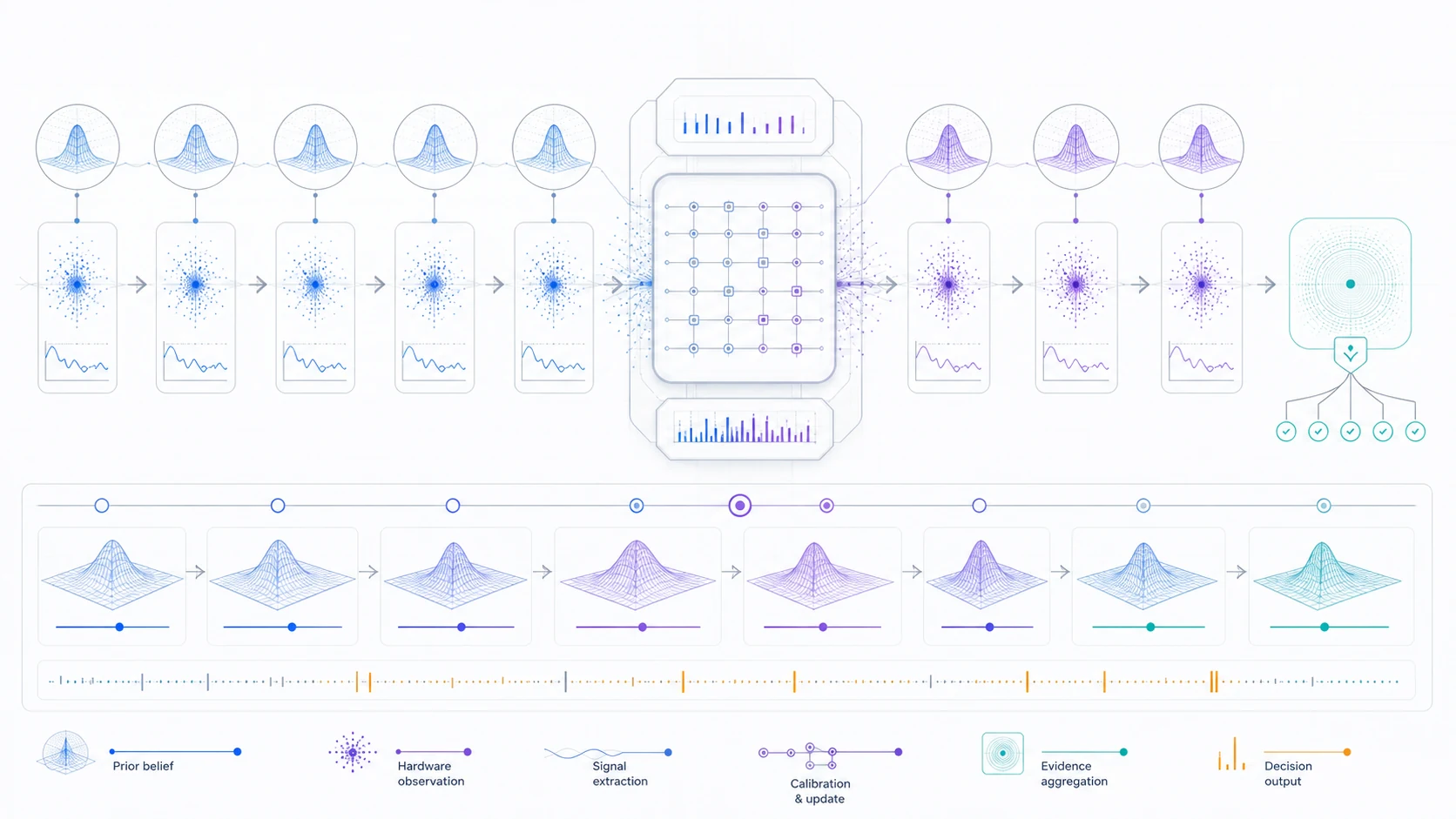
The second QANTIS preprint went up yesterday as arXiv:2607.06760. It is a narrower paper than the first one, and that is the point.
The foundational study, arXiv:2603.00785, ran 45 experiments across three IBM Heron backends and asked whether the belief-update mechanism works on real hardware at all. It does, within stated conditions. A Tiger belief-oracle case amplified a rare observation probability from 0.179 to 0.907 while preserving the posterior at a Hellinger distance of 0.0015 from exact Bayes. That is a clean mechanism result.
But a clean mechanism result answers a question nobody planning a real system is asking. They want to know what happens on the eighth call, and the twelfth, and whether the thing degrades gracefully or falls off a cliff.
The actual question
Sequential decision-making is where quantum components tend to get quietly abandoned. A single circuit can look excellent. Chain twenty of them inside a loop where each posterior feeds the next belief state, and error accumulates in ways that a one-shot benchmark will never reveal.
So the follow-on study embeds the calibrated belief-update service inside a classical planner and runs it around the loop. Primary campaigns cover 8-step and 12-step decision trajectories. Controls extend to 20 and 32 steps, specifically to find where the behaviour changes.
The reported finding is that hardware-derived and exact-Bayes posteriors selected the same immediate action at every decision point checked. That is a decision-level result rather than a fidelity result, and I want to be precise about the difference.
Posterior fidelity tells you how close two distributions are. Decision consistency tells you whether the difference between them ever mattered. Those come apart. A posterior can drift measurably and still produce identical actions, because the planner only needs the ordering to hold near the decision boundary. Equally, a small drift at the wrong moment can flip an action. Reporting fidelity alone would have obscured this.
What stays classical
The planner is classical. The action authority is classical. The quantum processor handles one bounded primitive inside a loop that a classical system owns end to end.
This is an architectural commitment rather than a temporary limitation waiting for better hardware. If the quantum component fails, degrades or becomes unavailable, the system falls back to a classical path that was already there. The alternative, in which quantum sits on the critical path for a decision that carries consequence, is not a design I would put in front of anyone.
What the paper does not claim
No wall-clock advantage over strong classical methods. The paper does not contain that claim and I will not make it in a summary.
No universal scaling. The results hold within the stated POMDP, hardware, calibration and experiment settings, and the honest reading is that we found an operating envelope, not a general capability.
No production readiness or certification. This is a preprint on arXiv. It has not been through peer review, and describing it as though it had would be a straightforward misrepresentation.
Why publish a bounded result
There is a temptation in this field to hold work back until it says something larger. I think that is a mistake, and I think it is part of why quantum computing has an evidence problem.
A bounded result that states its limits is more useful to another researcher than an unbounded claim that does not. If someone reads the sequential study and concludes that the operating envelope is too narrow for their application, the paper has done its job. It has saved them a campaign.
The reproducibility surface sits in the public repository alongside both papers. What is public is the explanatory edition rather than the full experimental tooling, and I say so on the page rather than implying otherwise.
Both papers are on arXiv, both are first-author, and neither has been peer-reviewed. All three of those facts belong in the same sentence.