Reproducibility is a product decision
Nobody reconstructs a quantum experiment from memory two months later. The tooling either captured it or it did not.
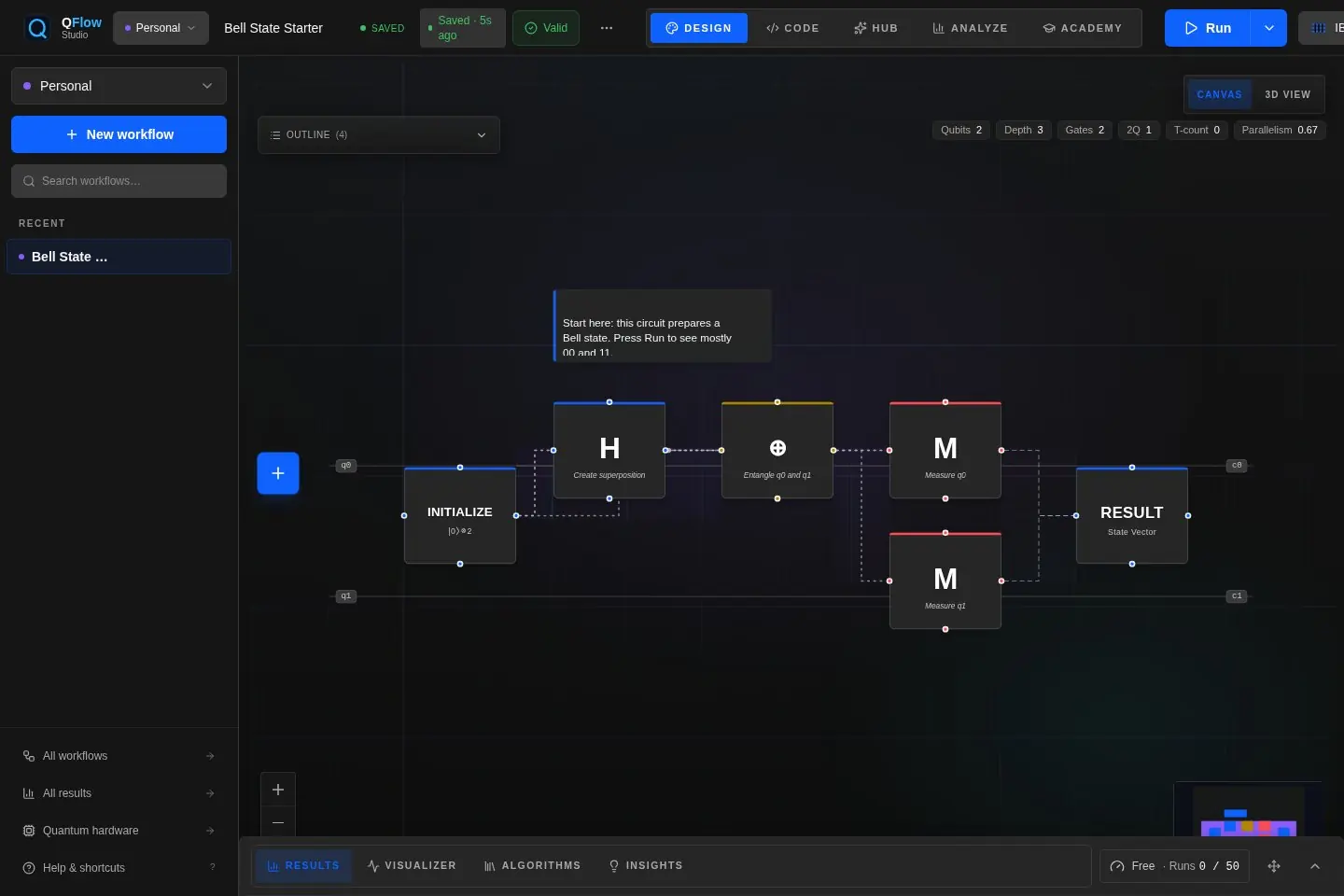
Quantum work fragments. The objective lives in a document, the circuit in a notebook, the generated source in a repository, the provider route in a console, the run log in a dashboard, and the review in a thread somewhere. Each of those is reasonable on its own. Together they guarantee that two months later nobody can reconstruct what was actually run.
I have watched this happen to careful people. It is not a discipline problem. It is a tooling problem that gets misdiagnosed as a discipline problem, which is why exhorting researchers to be more rigorous never fixes it.
What the record has to hold
QFlow Studio treats the whole thing as one controlled record: brief, circuit, source, route, run, evidence.
The brief carries the objective, the owner and the constraints, because a result without its original question is very hard to interpret later. The circuit is the visual graph. The source stays synchronised across Qiskit, Cirq and OpenQASM, so the code you read is the code that ran. The route captures provider fit, preflight and fallback, which matters because the same circuit on a different backend is a different experiment. The run holds the execution context. The evidence packet holds the result, the trace and the review state.
The point of putting them in one record is not tidiness. It is that the links between them are where the meaning lives. A result is only interpretable next to the calibration conditions it was taken under.
Reviewer-safe by construction
There is a second problem underneath the first. Provider credentials and share-safe evidence are different categories of thing, and most workflows mix them because the fastest way to show someone a result is to show them your console.
Separating them at the data model level means an evidence packet can be handed to a reviewer, a collaborator or an auditor without a redaction step. Redaction that happens at share time is redaction that eventually gets forgotten.
Where the AI boundary sits
AI may draft. Consequential execution stays user-approved.
I hold that line firmly, and the reason is not caution about model quality. It is that submitting a job to hardware costs money, consumes a queue slot and produces a record. Those are consequences. A system that can produce consequences without a person in the loop needs a much stronger justification than convenience, and I have not seen one for this workload.
What is actually claimed
The innovation here is the operating and evidence model around existing quantum toolchains. It is not a new SDK. It does not cover every backend. It makes no claim about quantum performance, and the product surface says so.
I am specific about this because the adjacent claim is available and tempting. A platform that sits above the SDKs could easily be described as though it improved what the SDKs do. It does not. It improves what happens around them, which is a smaller claim and a true one.