How will we verify identity in the quantum age?
Germany’s quantum-resistant identity research raises a wider question: how should AI agents and robots prove who they are, whose authority they carry and when it expires?


A robot receives an inspection task, loses its connection and carries on with the work it was allowed to do. While it is offline, an operator withdraws that permission. When the connection returns, the robot still holds a correctly signed command. Should it continue?
That is an illustrative situation, but it captures a question I keep returning to in distributed and autonomous systems: how do we prove both who a system is and what it is allowed to do, under the conditions that exist now? Post-quantum cryptography makes that question more urgent because the foundations of the proof must also survive a change in computing power.
What Germany’s digital identity research tells us
Germany’s Quant-ID project explored post-quantum protection for identity and access management, alongside a quantum random number generator. Its scope reaches into the infrastructure that authenticates users and authorises access. That matters because a stronger algorithm only helps when the surrounding system can actually use it.
A separate development makes the hardware challenge tangible. In November 2025, G+D and Bundesdruckerei reported an identity-card demonstrator, initiated with BSI and implemented on Infineon chips, combining classical and post-quantum cryptography. This was a proof of concept, rather than a nationwide rollout of quantum-resistant cards.
For me, these projects point towards an architectural responsibility: credentials, readers, services and trust relationships have to evolve together. The same responsibility will follow digital identity beyond people, into software agents, machines and organisations that delegate work to one another.
Identity proves a subject. Authority limits an action.
When an AI agent books a service for a person, the useful question goes beyond its account name. Which particular agent instance is acting? On whose behalf? For which task, budget and period? Can it delegate the task again? A valid credential cannot answer all of those questions by itself.
The distinction becomes physical in robotics. A maintenance robot may be allowed to observe a machine without being allowed to stop it. Another may move a component but require human approval before changing a safety setting. If an agent forwards a task, its delegation should remain within the authority it received; delegation should never silently expand permission.
A digital signature helps establish the origin and integrity of a message under its cryptographic assumptions. The system still needs to decide whether the signing key is trusted, whether its holder was authorised and whether the action is appropriate now. Even a quantum-resistant signature does not prove that a model’s answer is correct or that a robot’s physical behaviour is safe.
A robot reconnects. Is its permission still current?
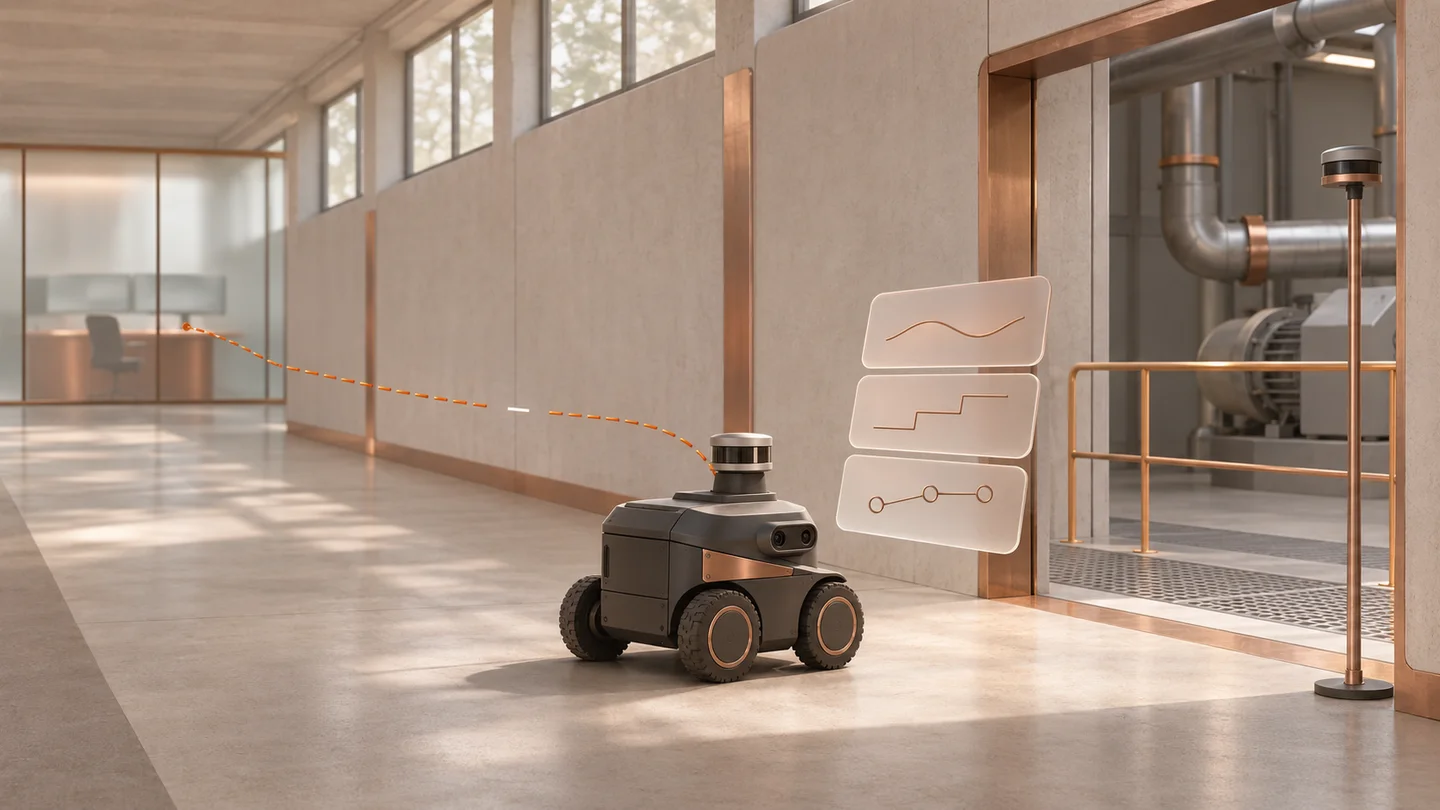
Return to the inspection robot. Before losing its connection, it received a task with a defined area and an expiry time. During the outage, it can only reason from information already available locally. It cannot guarantee knowledge of a revocation that never reached it. The design has to make that uncertainty explicit.
My preferred starting point is a bounded offline permission, tied to the task and the risk of the action. It needs a trustworthy way to assess its validity period, rules for replayed commands and a safe response when time or context becomes uncertain. Some inspection work may continue within those limits; a higher-consequence action may need to wait for renewed approval.
On reconnection, the robot should reconcile the task with current policy and revocation information before accepting queued commands. Its record should distinguish an instruction received, an instruction accepted and an action performed. Those are different events. Preserving the difference makes later review possible without pretending the robot knew what happened elsewhere during the outage.
Our proposed contribution: keep authority with the mission
The contribution I want to develop from our work on distributed coordination is a practical, testable mission authority record. Think of it as the context a receiving system needs before it acts. This is a proposed engineering direction, not a new cryptographic standard or an announced product feature. It brings together six questions that are too easy to scatter across separate logs:
- Actor: which person, agent instance or device is making the request?
- Delegation: who granted the authority, and how far may it be passed on?
- Scope: which task, resources, location and actions are permitted?
- Validity: when does permission expire, and how is freshness assessed offline?
- Policy: which rules, approval conditions and revocation state informed the decision?
- Evidence: what was requested, checked and executed, using which keys and software versions?
A useful first experiment would compare the same inspection task under a stable connection, a prolonged outage and a revoked permission after reconnection. We would measure rejected stale commands, time to recover current policy, communication overhead and the completeness of the resulting record. These are proposed acceptance criteria, not results we have already obtained.
- Verify the actor
- Check the current authority
- Preserve the action record
Post-quantum migration is a system change
A sufficiently capable future quantum computer would threaten widely used RSA and elliptic-curve public-key systems. Post-quantum cryptography develops alternatives intended to resist such attacks on ordinary computing hardware. A team does not need a quantum computer to deploy PQC. A quantum source of randomness, on its own, does not make RSA or ECC quantum-resistant.
There is already a standards foundation. NIST approved FIPS 203, 204 and 205 in August 2024: ML-KEM for key establishment, and ML-DSA and SLH-DSA for digital signatures. Key establishment and signing serve different purposes; an identity architecture needs to select and integrate the right mechanisms for each.
For an engineering team, I would start by inventorying certificates, service identities, firmware signatures, update channels and long-lived records. Then trace who trusts each key, how it rotates and what fails when an algorithm changes. NIST’s guidance on cryptographic agility addresses this ability to change cryptography while preserving security and ongoing operations.
The next step is to test on the devices and networks that will carry the system: memory use, signature size, verification time, energy demand and behaviour during interruptions. Hybrid designs also need explicit composition and downgrade rules. Long-term evidence deserves its own plan: preserve the original validation context and trustworthy time information, and renew protection before older mechanisms become unreliable.
Where QFlow helps you start today
Our contribution at Neura Parse starts with making technical decisions and their evidence easier to inspect. In NODERIQ’s distributed coordination work, the question is how a mission can retain useful context when communication becomes unreliable. In QFlow, it is how a quantum experiment can keep its question, circuit, source and result connected. Those concerns meet in a shared engineering habit: keep enough context for another person to check the decision.
You can start with QFlow today. Open the public circuit example, follow it into the source and change one gate to inspect the result. It is a practical introduction to quantum computing without needing a hardware connection. For a team discussion, use the demo request on the site to walk through your experiment and review requirements.
That starting point supports quantum learning and inspectable experiments. QFlow is not presented here as a PQC identity provider, a certificate authority or a deployed robot authorisation service. The mission authority proposal needs its own implementation and security evaluation. Keeping that boundary clear makes the invitation useful: begin learning now, and define the identity experiment with the right tools and collaborators.
If your team works on digital identity, post-quantum integration or autonomous systems, let’s shape a bounded research collaboration: one task, a clear threat model and evidence that another team can examine. That is where I think we can make a useful contribution to an international problem.
As machines become more capable, we will also need better answers about what they are authorised to do and how their actions can be checked. Preparing for the quantum age begins with building those trust relationships into the systems we design today.
Sources
- Quant-ID: quantum-secure digital identities quant-id.de
- G+D and Bundesdruckerei: German identity-card demonstrator, November 2025 gi-de.com
- NIST: Post-Quantum Cryptography project csrc.nist.gov
- NIST: approval of FIPS 203, 204 and 205, August 2024 nist.gov
- NIST CSWP 39upd1: cryptographic agility, updated June 2026 csrc.nist.gov
- QFlow Studio: public circuit example and workflow demo qflow.studio